
Online Spanish classes and language-learning apps are two popular ways to learn Spanish today.
But many learners still ask the same question: what’s the best way to learn Spanish?
The truth is that both options can help, but they work in different ways and support different learning goals.
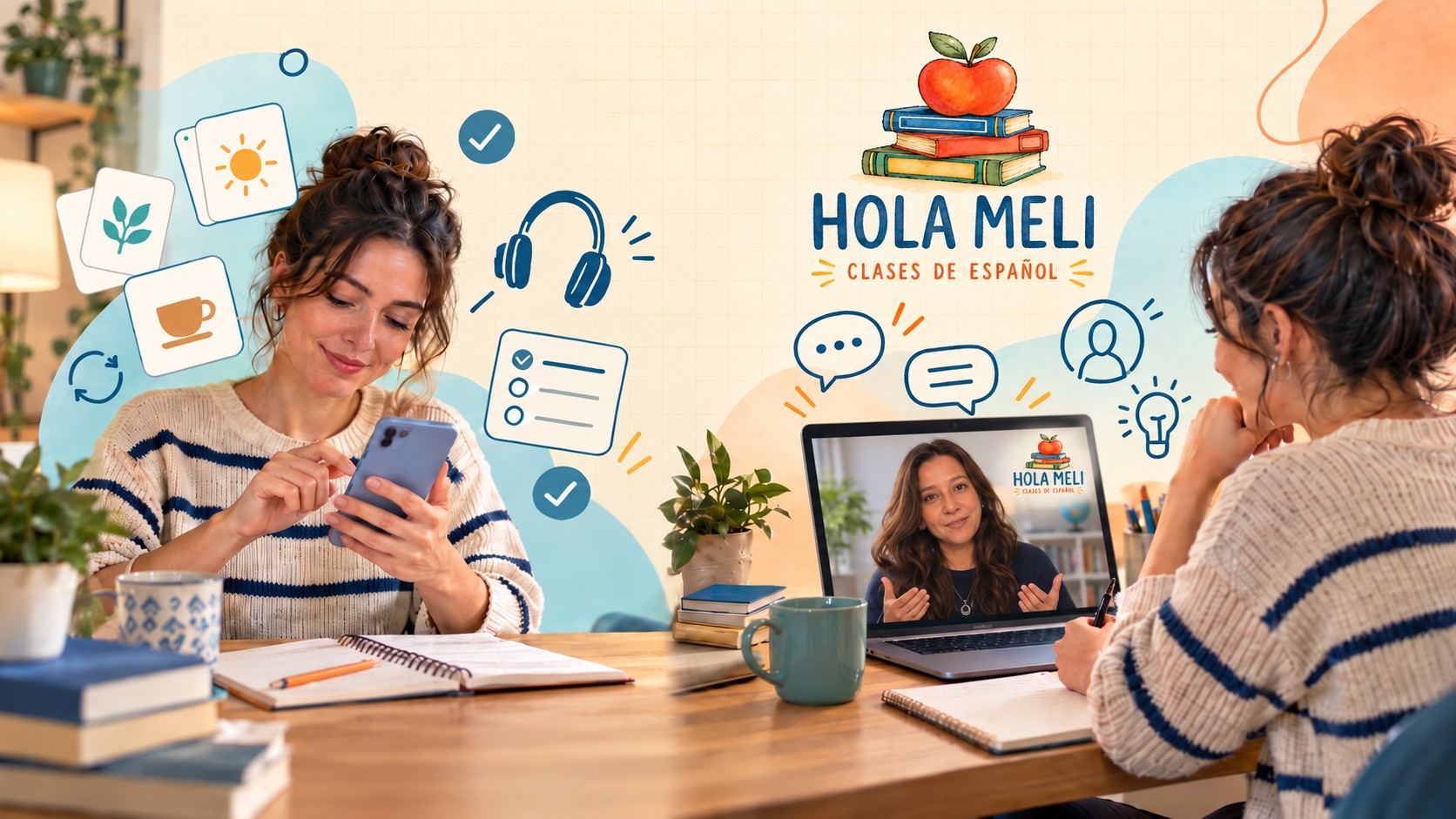
Learning Spanish with an App
Apps are a practical way to include Spanish in your daily routine. You can practice for a few minutes every day, learn new vocabulary, and review basic structures from anywhere.
They are especially useful for building a habit, practicing vocabulary, reviewing grammar, and staying in regular contact with the language.
But completing exercises correctly doesn’t always mean you can have a real conversation.
You may know plenty of words and still freeze when someone asks you:
- Where are you from?
- What do you do?
- What did you do last weekend?
Speaking requires a different kind of practice.
What Do Online Spanish Classes Offer?
In a class, you have to listen, understand, and respond in real time.
This helps you turn what you have studied into real communication.
You can also receive corrections and explanations based on your specific difficulties.
For example:
❌ Soy cansado.
✅ Estoy cansado. — I’m tired.
A teacher can help you understand why you made the mistake and focus on what you actually need to improve: conversation, grammar, pronunciation, Spanish for travel, or everyday situations.
Apps vs Online Spanish Classes
| Apps | Online classes |
|---|---|
| Independent practice | Real conversation |
| Vocabulary and exercises | Active use of Spanish |
| Automatic corrections | Personalized feedback |
| Flexible schedule | Content adapted to your goals |
| Good for building a habit | Good for building speaking confidence |
You don’t have to choose only one option.
When Are Online Spanish Classes Worth It?
Online classes can be especially useful when you understand more Spanish than you can actually speak.
They can also help if you have been studying for a while but keep making the same mistakes, want to improve your pronunciation, or need Spanish for travel, work, or everyday communication.
In these situations, practicing with a teacher can help you turn passive knowledge into Spanish you can actually use.
The Best Option May Be to Combine Both
An app can help you practice for a few minutes every day, while a class gives you the opportunity to use that vocabulary and grammar in a real conversation.
You can also support your learning by listening to music and podcasts, watching videos, or reading simple texts in Spanish.
The goal is not to find one perfect tool. It is to use each resource for what it does best.
What If You’re a Beginner?
You don’t need to learn all the grammar before you start speaking.
You can communicate from your very first day with simple sentences:
- Hola, me llamo Anna. — Hi, my name is Anna.
- Soy de Alemania. — I’m from Germany.
- Vivo en Berlín. — I live in Berlin.
- Me gusta viajar. — I like travelling.
That is already real communication.
So, What’s the Best Way to Learn Spanish?
Apps can help you build a habit and practice regularly.
Online classes can help you speak, receive feedback, and learn in a way that is adapted to your goals.
For many students, the best combination is:
independent practice + exposure to Spanish + real conversation.
Want to Practice Spanish with a Personalized Approach?
At Hola Meli, you can find personalized online Spanish classes adapted to your level, goals, and learning pace.
Explore my personalized online Spanish lessons and discover how we can work together.
If you are still at the beginning of your Spanish journey, you can also take the free Spanish Level Test or download the first two units of the Spanish Workbook for beginners for free.