
How to Start Learning Spanish (Beginner Guide)
Starting to learn Spanish can feel overwhelming—but it doesn’t have to be.
Many beginners don’t know where to start, what to study, or how to make real progress. The good news is that with the right approach, you can start speaking Spanish sooner than you think.
In this guide, I’ll show you how to start learning Spanish step by step in a simple and effective way.
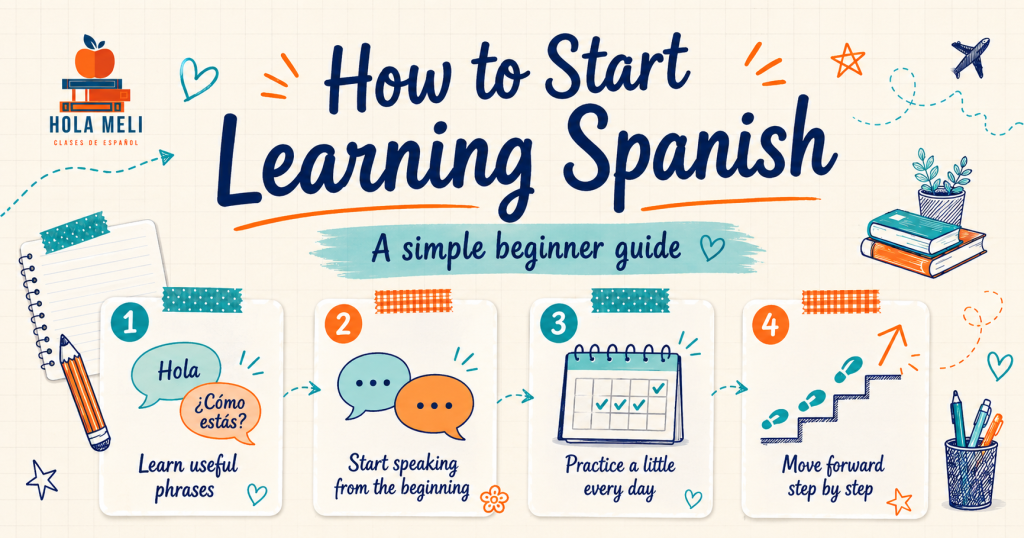
1. Start with Simple and Useful Phrases
When you begin learning Spanish, it’s important to focus on what you can actually use in real life.
Instead of memorizing long grammar rules, start with simple phrases like greetings, basic questions, and everyday expressions.
This will help you build confidence and start communicating from day one.
2. Focus on Speaking from the Beginning
One of the most common mistakes is waiting too long to speak.
You don’t need to be perfect to start speaking Spanish. In fact, speaking early is what helps you improve faster.
Even if you make mistakes, you are learning—and that’s what matters.
3. Be Consistent (Even a Few Minutes a Day)
Consistency is more important than studying for long hours.
Practicing Spanish for 10–15 minutes every day is much more effective than studying once a week.
Small steps, repeated daily, lead to real progress.
4. Learn with Guidance and Structure
Learning on your own can feel confusing and slow.
Having a teacher or a structured plan helps you:
– Stay focused
– Learn what really matters
– Improve faster
– Stay motivated
With the right guidance, you avoid wasting time and start seeing results sooner
5.Make Spanish Part of Your Daily Life
Try to include Spanish in your routine as much as possible:
– Listen to Spanish music
– Watch short videos
– Repeat phrases out loud
– Practice whenever you can
The more you expose yourself to the language, the more natural it becomes.
How to Start Learning Spanish Step by Step
If you are wondering how to start learning Spanish, the best approach is to keep your routine simple and realistic. You do not need to study for hours every day or memorize long lists of grammar rules. Begin with useful words and phrases that you can use in real conversations, and practice them regularly.
Listening is also important from the beginning. Try short Spanish videos, beginner podcasts, or simple conversations and focus on understanding the general meaning rather than every single word. Repeating short sentences out loud can help you improve pronunciation and become more comfortable speaking.
Another useful habit is to review what you learn instead of constantly adding new material. Practice the same vocabulary and expressions several times during the week until they begin to feel natural. Small, repeated steps are usually more effective than studying a lot in one day and then stopping for several days.
Most importantly, allow yourself to make mistakes. Learning Spanish takes time, and every conversation gives you an opportunity to improve. Stay consistent, practice regularly, and focus on progress rather than perfection.
Start Learning Spanish Today
If you want to learn Spanish in a practical, simple, and personalized way, I can help you.
I offer online Spanish lessons designed for beginners and adapted to your level and goals.
Ready to start learning Spanish?
Final Tip:
Don’t wait until you feel “ready.”
Start with what you know, practice consistently, and enjoy the process.
Learning Spanish is a journey—and every small step brings you closer to speaking with confidence.
Knowing how to start learning Spanish is easier when you focus on small, consistent steps.