
Learning Spanish is exciting—but beginners often make the same mistakes.
The good news? These mistakes are completely normal, and once you’re aware of them, you can improve much faster.
Here are 10 common Spanish mistakes beginners make—and how to fix them.
1. Translating Everything Literally
Many students try to translate directly from English to Spanish.
❌ This often leads to unnatural sentences.
✅ Instead, learn common phrases and how native speakers actually express ideas.
2. Not Practicing Speaking
You might understand a lot… but struggle to speak.
❌ Studying without speaking slows your progress.
✅ Practice speaking from the beginning—even if you make mistakes.
3. Focusing Too Much on Grammar
Grammar is important—but not at the beginning.
❌ Overthinking grammar can stop you from speaking
✅ Focus first on communication, then improve accuracy over time.
4. Being Afraid of Making Mistakes
This is one of the biggest obstacles.
❌ Fear stops you from practicing.
✅ Mistakes are part of learning—every error helps you improve.
5. Not Being Consistent
Studying once in a while is not enough.
❌ Irregular practice slows your progress.
✅ Practice a little every day.
6. Ignoring Pronunciation
Pronunciation matters more than you think.
❌ Mispronunciation can lead to misunderstandings.
✅ Listen carefully and repeat words out loud.
7. Learning Words Without Context
Memorizing isolated words is not effective.
❌ You may forget them quickly.
✅ Learn words in phrases or sentences.
8. Not Listening Enough
Understanding spoken Spanish is essential.
❌ If you don’t listen, you won’t understand real conversations.
✅ Use videos, podcasts, and audio regularly.
9. Trying to Learn Too Much at Once
Too much information can be overwhelming.
❌ This leads to frustration.
✅ Focus on small, manageable steps.
10. Learning Without Guidance
Learning alone can be confusing.
❌ You may not know what to focus on.
✅ A teacher helps you stay on track and improve faster.
How to Avoid Common Spanish Mistakes
Making mistakes is a normal part of learning Spanish, but a few simple habits can help you avoid repeating the same ones. Start by paying attention to complete phrases instead of translating word by word from English. Spanish often expresses ideas differently, so learning expressions in context will help you sound more natural.
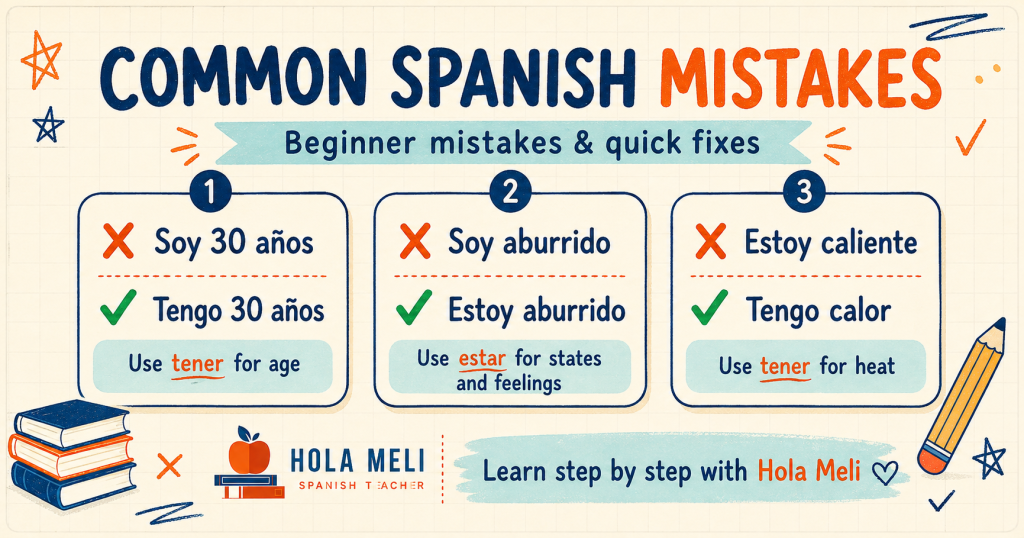
Listen to native speakers as often as possible and repeat short sentences out loud. This will help you improve pronunciation, rhythm, and sentence structure at the same time. It is also useful to keep a small list of the common Spanish mistakes you make most often, such as confusing ser and estar, using the wrong verb for age or feelings, or forgetting gender agreement.
Finally, practice regularly and ask for feedback when possible. Correcting small errors early makes them easier to remember and helps you build confidence. The goal is not to speak perfectly from the beginning, but to notice your mistakes, understand them, and improve step by step.
A useful habit is to review your corrections after each practice session. Choose one or two mistakes to focus on at a time instead of trying to fix everything at once. This makes progress easier to notice and helps the correct Spanish forms become more natural.
How to Fix Common Spanish Mistakes
If you want to avoid these mistakes and make real progress, I can help you.
I offer personalized online Spanish lessons designed for beginners.
Not sure about your current Spanish level? Take my free Spanish Level Test to see what you already know and what to practice next.
👉 Start here:
https://holameli.com/learn-spanish-online/
Final Thought
These common Spanish mistakes are a normal part of learning. What matters is noticing them, understanding why they happen, and practicing the correct forms little by little.
Stay consistent, keep practicing, and enjoy the journey.